Archive for the ‘Travel to Morocco’ Category

Moroccan Seffa Medfouna Recipe, Your Morocco Travel Guide

Monday, February 6th, 2012

Moroccan Seffa Dish

Seffa Medfouna is a famous Moroccan dish which is comprised of a large dome of steamed couscous or tiny vermicelli noodles (chaariya) that is sweetened with raisins, butter and powdered sugar. When traveling to Morocco for a Cooking Vacation or to take a Moroccan Cooking Workshop Seffa Medfouna is one of the options that Moroccan travelers can learn to make.

Seffa is made with fried almonds, cinnamon and powdered sugar as a garnish. Seffa Medfouna is often served before or after a meal. When making this typical Moroccan dish of Seffa Medfouna one can also choose to include saffron chicken, lamb or beef, which is concealed inside the mound of vermicelli noodles or couscous. Seffa Medfouna is a Moroccan favorite and also offered as an entree or after meal dish on a Morocco Tour in the Todra Gorge region of Southern Morocco.

10 Steps of the Preparation and Making of Seffa Medfouna in Morocco:

Step #1: Start by cooking the chicken, lamb or beef.

Step #2: Prepare the saffron chicken, which with Seffa Medfouna. No water should be added to the chicken during cooking as it forms a rich of its own. When cooking lamb or beef, however, using a little water is recommended.

Step #3: While the meat is cooking, steam the broken vermicelli noddles four or five times, or the couscous three times.

Step #4: Start by filling the base of a couscoussier  halfway with salted water, and bring it to a boil. Once boiling, reduce the heat to medium-low, enough to keep the water simmering rapidly.

Step #5: Next, mix 3 tablespoons of oil into 2 lbs. (about 1 kg) of dry, broken vermicelli noodles. Be sure all the strands are coated with oil.

Step#6: Transfer the oiled vermicelli noodles to the steamer basket, and place atop the couscoussier. Allow to steam for at least 20 minutes, timing from when you see the steam rise from the vermicelli. Watch for the ends of the broken vermicelli to poke up.

Moroccan Seffa Medfouna

NOTE: When using a couscoussier, be sure that no steam escapes from the joint where the steamer meets the base. If steam escapes, seal the joint. You can do this in one of several ways: Either wrap and tie a long piece of damp cloth over the joint, or tightly wrap a long piece of kitchen plastic film around the joint, or wrap and drape a long piece of kitchen plastic film onto the rim of the couscoussier, and then place the basket on top (this is my preferred method). Be sure to seal the joint if necessary each time you steam the vermicelli.

Step #7: Turn the vermicelli noodles out into a very large bowl. Break it apart, and mix in about 1 1/4 cups water. The vermicelli should absorb most of it.

Step #8: Put the vermicelli back into the steamer, and place it atop the couscoussier for the second steaming. Allow to steam again for 20 minutes, timing from when you see the steam rise through the vermicelli.

Step #9: Turn the vermicelli out into a large bowl, and break it apart. Stir 2 teaspoons of salt into 2 cups of water, and add this to the vermicelli, tossing to mix well.Put the vermicelli back into the steamer, and steam for a third time for 20 minutes. Again, time the steaming from when the steam rises from the vermicelli, and watch for the ends to poke up.

Step #10: Add raisins. Turn the steamed vermicelli out into your large bowl. Break it apart, and mix in 1 cup of soaked golden raisins and 1 cup of water.Transfer the vermicelli back into the steamer, and place atop the couscsoussier. Steam for a fourth time, again about 20 minutes, timing from when the steam rises through the vermicelli. Test the vermicelli. If you want it a little more tender, steam for a fifth time.

The final making of Morocan Seffa Medfounda – For this final steaming of the vermicelli, add only enough water – up to a cup – to make it a little more tender. Place back into the steamer, and steam for the final time for another 20 minutes. It should now be ready to serve.

To serve Seffa Medfouna, first sweeten the steamed couscous or steamed vermicelli. In a large bowl, gently mix 4 tablespoons soft unsalted butter and 1 cup powdered sugar (or to taste) with the couscous or vermicelli.

Place about a third of the sweetened couscous or vermicelli on a large serving platter. Arrange the chicken or meat over this mound, and cover with the sauce. Mound the remaining couscous or vermicelli into a dome, fully concealing the chicken or meat. Decorate the dome with ground cinnamon, ground fried almonds and powdered sugar. This is usually done in alternating vertical lines. Serve the Seffa Medfouna with small bowls of cinnamon, powdered sugar and almonds on the side. Traditionally each guest eats from his own side of the plate, adding additional powdered sugar, cinnamon and almonds as desired.

Regardless of ones cooking skills Moroccan Seffa Medfouna is easy to make on a Moroccan Vacation that provides a cooking workshop or  at home on your own.

For more information about a Morocco Cooking Vacation or Making Seffa Medfouna

Discover The Best of Morocco - Travel Exploration

Travel Exploration specializes in Morocco Travel. We provide Tours and travel opportunities to Morocco for the independent traveler and tailor-made tours for families and groups with a distinctly unique flavor. From Morocco’s Seven Imperial Cities, to the Magical Sahara Travel Exploration offers a captivating experience that will inspire you. At Travel Exploration we guarantee that you will discover the best of Morocco! Call Travel Exploration in the USA at 1 (800) 787-8806 or in Morocco 1 (212)618-88-26-81 and let’s book a tour to Morocco for you today.


Yves Saint Laurent Exhibition at Majorelle Gardens In Marrakech, Your Morocco Travel Guide

Friday, December 3rd, 2010

Yves Saint Laurent Exhibition Postcard

Yves Saint Laurent Exhibition Postcard

Forty-four fashion creations that demonstrate Yves Saint Laurent’s love of Morocco are currently being showcased at the Majorelle Gardens in Marrakech from November 27th, 2010 – March 18th, 2011. This exhibition at the Majorelle Gardens brings to life haute couture designs inspired by the country he loved.

Princess Lalla Salma attended the inauguration ceremony of the ‘Yves Saint Laurent and Morocco’ exhibition that was organized under the patronage of King Mohammed VI. The Princess visited the different shelves and areas of this state of the art exhibition that is sumptuously accessorized and accompanied by a series of pictures documents and sketches.

Princess Lalla Salma at Yves Saint Laurent Exhibition Majorelle Gardens

Princess Lalla Salma at Yves Saint Laurent Exhibition Majorelle Gardens

The Yves Saint Laurent exhibition presents a very-well designed interior of a Moroccan house. It includes reinterpretations by Saint Laurent of caftans (traditional clothes for women), Capes, Sarouels with Moroccan embroideries (traditional trousers for men) and soft furnishings.

Yves Saint Laurent Exhibition Space

Yves Saint Laurent Exhibition Space

Cloaks, embroideries, Turkish trousers, head coverings and flowing Moroccan style gowns; the creations on show make explicit reference to the Moroccan clothing tradition that inspired Yves Saint-Laurent. Their colors also evoke those admired by the artist in Marrakech: the orange of saffron, the blue of the Majorelle Gardens, and the violet of the bougainvillea. “This city led me to color,” Saint- Laurent often said.

The exhibition’s curator, the designer’s partner and collaborator Pierre Bergé, views this exhibition as a “tribute from Yves Saint Laurent to the inhabitants of Morocco, to the sky of Marrakech and its light.” The couple bought three houses there, including the one in Majorelle that now houses the Pierre Bergé-Yves Saint-Laurent Foundation.

Yves Saint Laurent Exhibition Room, Christophe Martin Stage Designer

Yves Saint Laurent Exhibition Room, Christophe Martin Stage Designer

A dark, starlit room within the exhibition space that showcases Yves Saint Laurent’s pieces has a mirrored ceiling from top to bottom and creates an ambiance of luster. Christophe Martin the stage designer takes the visitor outside the house into nature in this room called “Color.” Another area dubbed “Ideal Africa” houses timeless items made of surprising substances mainly wooden beads mica and raffia.

Yves Saint Laurent Exhibition Entrance

Yves Saint Laurent Exhibition Entrance

Every footstep throughout the exhibition space, beginning with the entrance, makes one forget time and space encouraging the opportunity to get lost into a dreamland of wonder and color. While the exhibition does lack  a detailed descriptive time line next to each piece and a detailed overview of Saint Laurent’s life and history in Morocco, none the less the inspiration of his work shines through.  Some may equivocate this showing as an art- fashion installation rather then an actual exhibition as a result of its intense usage of free form set design, color and space that is of perfect elegance and scale.

Yves Saint Laurent Exhibition Book

Yves Saint Laurent Exhibition Book

A book of the exhibition, “Yves Saint Laurent, Une Passion Marocaine” with a symbolic snake bracing the cover, created  by the Pierre Bergé-Yves Saint Laurent foundation is available for sale and its contents are as beautifully created as is his designer clothing.

Yves Saint Laurent, Marrakech

Yves Saint Laurent, Marrakech

Yves Saint Laurent’s passion for Morocco dates back to his arrival in Marrakech in 1966. From that day onwards he considered Morocco his second home.  It was Morocco where he first came across the magic of color and he reclaimed “when I discovered Marrakech, it was an extraordinary shock. The city taught me color.” In 1980 Saint-Laurent purchased The Majorelle Garden that was threatened with destruction and together they restored and saved it from ruin.

Majorelle Gardens, Marrakech

Majorelle Gardens, Marrakech

The Majorelle Garden, previously the Jardin Bou Saf, bears its name from its original creator, Jacques Majorelle, the French expatriate artist who was born in Nancy France in 1886. Jacques Majorelle was the son of the celebrated Art Nouveau furniture designer Louis Majorelle. In 1947 he opened his gardens to the public and during this time also painted a magnificent ceiling space at La Mamounia, a five-star hotel with gardens and the place where Alfred Hitchcock wrote, “The Birds.”

Jacques Majorelle studied at the École des Beaux-Arts in Nancy in 1901 and later in 1919 he went to Marrakech, Morocco to recover from heart problems. He built the garden during those years using special color of blue which he used extensively in the garden that is named after him, Majorelle Blue. Jacques Majorelle returned to France in 1962 after a car incident and died later that year of complications from his injuries. As a collector of unique plants from five continents Jacque Majorelle left to Saint Laurent one of the more unique collections of flore and fauna of this era as well as a place of inspiration and contemplation. Even though Morocco is no longer under the French protectorate, this originally French creation is one of the most beloved areas in Morocco.

The power of the blue Majorelle is long lived and permeates the essence of what it means to live and see color in Marrakech.

For More Information about Marrakech Tours or the Majorelle Gardens

For more information about Travel and Tours to Morocco plus highlights on Moroccan culture visit Morocco’s Imperial CitiesSeaside Resorts,Sahara DesertBerber villagesA Taste of MoroccoMagical Kasbahs, Ruins & WaterfallsAbsolute Morocco, The Best of MarrakechFes, and Ouarzazate

Discover The Best of Morocco - Travel Exploration

Travel Exploration specializes in Morocco Travel. We provide Tours and travel opportunities to Morocco for the independent traveler and tailor-made tours for families and groups with a distinctly unique flavor. From Morocco’s Seven Imperial Cities, to the Magical Sahara Travel Exploration offers a captivating experience that will inspire you. At Travel Exploration we guarantee that you will discover the best of Morocco! Call Travel Exploration at 1 (800) 787-8806 or 1 (917)703-2078 and let’s book a tour to Morocco for you today.

Yves Saint Laurent Exhibition, Yves Saint Laurent Exhibition Majorelle Gardens, Yves Saint Laurent Exhibition Marrakech, Yves Saint Laurent, Yves Saint Laurent and Morocco, Majorelle Gardens, Majorelle Gardens Marrakech, Jacque Majorelle, Yves Saint Laurent and Pierre Bergé, Pierre Bergé, Pierre Bergé, Yves Saint Laurent Fashion Designer, Marrakech, Marrakech Tour, Marrakech Majorelle Garden, Princess Lalla Salma, Mohammed VI,  Morocco private tours, Morocco Holidays, Morocco Travel, Travel Exploration, Travel to Morocco

Moroccan Cooking Classes, Your Morocco Travel Guide

Sunday, October 24th, 2010
Moroccan Cooking Class Chef

Moroccan Cooking Class Chef

If you’re planning a Morocco vacation one of the best ways to discover the culture of the Maghreb is to taking a cooking class or a private, cooking course in Morocco’s Imperial Cities of Marrakech and Fes or consider a Moroccan culinary tourMarrakech and Fes offer some of the Morocco’s best cooking classes as a result of their subculture and history of fine cuisine alongside being able to lay claim to some of the best restaurants in Morocco.

A Morocco cooking class usually starts with a comprehensive introduction that highlights the importance of cooking in Moroccan society, and reviews the variety of recipes created by dadas (traditional woman cooks) over the centuries for special occasions such as marriages, holidays such as Ramadan, Eid El Kebir, Moroccan baptisms, and circumcisions.

Moroccan Spices

Moroccan Spices

Before taking a cooking class in Morocco most leading chefs will take you on a tour of the Marrakech or Fes medina on a tour and in search of the most favored spices that are used in Morocco cooking. During your medina tour you will discover spices such as fresh cumin, ginger, wild saffron grown from the Moroccan city of Talouine, indigenous sea salt from the Souss region of Agadir and pepper.

Lahcen's Cooking Class, Spice Shopping Fes

Lahcen's Cooking Class, Spice Shopping Fes

The core spices used in Moroccan cuisine include ginger, saffron, Cumin, ras el hanout (a mixture of up to 35 different spices and a famous Moroccan must in any kitchen), as well as salt and pepper. Olive oil, of which there is an abundance in Morocco, is also an essential ingredient in the local cuisine, as well as ghi (a kind of aged butter).

Most Moroccan recipes use parsley and coriander. Other important herbs such as thyme, oregano, bay leaf, rosemary and basil, are used depending on the recipe being prepared.

Traditionally, Moroccan homes used charcoal and clay pots to cook tajines or couscous. Modern Moroccan homes of course use the same gas or electric ranges found in European or American homes.

Le Jardin Des La Medina Cooking Class, Marrakech

Le Jardin Des La Medina Cooking Class, Marrakech

The cooking workshops at in Marrakech at famous five star Riads such as Le Maison Arabe and Le Jardin Des La Medina are conducted using modern equipment, so that the participants can easily prepare the dishes they have learned once they have returned to their own countries. A typical Moroccan cooking class lasts approximately 3-4 hours depending on the dish of choice you have chosen to make.

The same goes for the top cooking classes in Fes at Lahcen’s Moroccan Cooking class and culinary tour which is acclaimed by the New York Times and also at Café Clock

Before beginning your Moroccan cooking workshop, your chef will first offer an an overview of the most traditional recipes such as pastilla, couscous, and the broad variety of tajines (stews usually made with lamb or chicken), while reviewing some of the basic pillars of Moroccan cuisine.

Then the class will begin and take you away on a Moroccan adventure that will fill tempt your pallet.

Tajine La Maison Arabe Cooking Class

Tajine La Maison Arabe Cooking Class

Moroccan cooking Techniques for a typical tajine recipe calls for searing the meat, softening the onions, bringing to a boil and allowing to slowly simmer. This results in a reduced, thick sauce.

Woman Making Pastilla

Woman Making Pastilla

Techniques for pastilla and couscous will also be reviewed. Finally, before the practical part of the cooking class begins, you will be acquainted with the recipe of the day, whether it’s a chicken tajine with olives and preserved lemons, couscous or pastilla, and review the various vegetables and ingredients that will be used.

Most Moroccan cooking classes are structured around easy-to- make traditional recipes. Each participant has his or her own workstation and equipment, and follows step-by-step the preparing of that day’s dish. In a typical workshop or Moroccan cooking class you will learn how to make a main course as well as a Moroccan appetizer or salad (for example, eggplant or roasted green peppers with tomatoes).

Pigeon Pastilla

Pigeon Pastilla

When the class has finished, you will be able to savor the result of your labor by enjoying the meal you’ve prepared, in the cool shade of an olive or fig tree or in a special part of the Riad where you have taken your Moroccan cooking class.

Listed below are sample offerings that La Maison Arabe in Marrakech has as options of what you learn to cook during your Moroccan cuisine adventure. These recipes duplicated by other cooking classes in Morocco using their own chef’s unique style:

Briouate class:
-Assortment of Moroccan briouates (turnovers) – cheese, chicken ground meat, vegetables and seafood

Pastilla class (choice of):
- Chicken with almonds
- Seafood
- Vegetables

Tajine class (choice of):
– Chicken tajine with lemon and olives
- Chicken tajine M’derbel (stewed tomatoes with cinnamon and
sesame seeds).
-Chicken tajine with almonds and boiled eggs
-Lamb tajine with dates and almonds
- Lamb tajine with figs and walnuts
- Beef or lamb tajine Makfoul (steamed tomatoes with small
onions)
- Lamb tajine with prunes and apricots

Couscous class (choice of):
– Chicken or lamb with caramelized onions
- Chicken or lamb with seven vegetables

For more information about Moroccan Cooking Classes or a Morocco Culinary Tour

For more information about Travel and Tours to Morocco plus highlights on Moroccan culture visit Morocco’s Imperial CitiesSeaside Resorts,Sahara DesertBerber villagesA Taste of MoroccoMagical Kasbahs, Ruins & WaterfallsAbsolute Morocco, The Best of MarrakechFes, and Ouarzazate

Discover The Best of Morocco - Travel Exploration

Travel Exploration specializes in Morocco Travel. We provide Tours and travel opportunities to Morocco for the independent traveler and tailor-made tours for families and groups with a distinctly unique flavor. From Morocco’s Seven Imperial Cities, to the Magical Sahara Travel Exploration offers a captivating experience that will inspire you. At Travel Exploration we guarantee that you will discover the best of Morocco! Call Travel Exploration at 1 (800) 787-8806 or 1 (917)703-2078 and let’s book a tour to Morocco for you today.

Moroccan Cooking Class, Moroccan Cooking Course, Moroccan Cooking Workshop, Moroccan culinary tour, Moroccan Chefs, Moroccan cuisine, Le Maison Arabe Cooking Workshop, Le Jardin Des La Medina Cooking Class, Lahcen’s Moroccan Cooking class, Café Clock, Morocco Cooking Class, Morocco Cooking Course, Morocco Cooking Workshop, Tajine, Chicken Tajine, Beef Tajine, Lamb Tajine, Pastilla, Chicken Pastilla, Pigeon Pastilla, Vegetable Pastilla, Couscous, Morocco private tours, Morocco Holidays, Morocco Travel, Travel Exploration, Travel to Morocco

Morocco Holiday Vacation Ideas, Your Morocco Travel Guide

Friday, October 22nd, 2010

Man Praying at Kairaouine Mosque Fes

Man Praying at Kairaouine Mosque Fes

Some of the best Morocco Holiday Vacations are those spent on an unwieldy adventure. Travel Exploration Morocco offers many holiday vacation opportunities that range from ancient Imperial city tours to majestic nights in the Sahara Desert Tours, a regional visit of Southern Morocco’s Valley of Nomads, Mount Mgoun and Draa Valley region along with customized cuisine tours and private dining experiences at some of Morocco’s best restaurants. Planning a Morocco Holiday Vacation for the Christmas or New Years is easy when using the private Morocco tour services of a Morocco travel agency.

Tomb of Koubba Lalla Zohra, Marrakech

Tomb of Koubba Lalla Zohra, Marrakech

Booking a private Morocco Holiday Vacation offers the option of spending your journey in a 4×4 land cruiser traveling across Morocco. Morocco is known for its incredible topography and variation of landscapes that take a Moroccan traveler on a unique adventure. The architecture of Morocco’s medersas and places are incredible.

Bahia Palace Marrakech, Koran Blessing

Bahia Palace Marrakech, Koran Blessing

The calligraphic work and ceiling treatments throughout Morocco’s palaces and Kasbahs is astonishing. A Morocco Holiday Vacation offers families and small groups a cultural experience as one moves from region to region using Travel Exploration’s well designed grand clockwise travel route beginning in Casablanca and ending in the seaside artist colony of Essaouira.

It is recommended to being a Morocco Holiday in Casablanca which boasts the incredible Hassan II Mosque to the Imperial City of Fes prized for it’s intellectual history, the old medina Fes El Bali whereby you see traditional craftsmanship of old techniques such as pottery, zellij tile and metal smithing.

Man Painting Pottery, Cooperative Fes

Man Painting Pottery, Cooperative Fes

There’s nothing quite like continuing a Moroccan vacation discovering the ancient ruins of Volubilis and the city of Meknes’ Moulay Ismail Mausoleum where the former Hassan II’s Berber wife has been laid to rest along with the Meknes Thursday Gate Bab El Khemis and the city’s tradition of weaving, created by Franciscan Nuns.

Stables Meknes

Stables Meknes

Any complete Morocco Holiday also offers a magical journey through the Merzouga Sahara Desert’s Erg Chebbi Dunes, the region of Bouthgrar’s Valley of Nomads and a special lunch experience with a Moroccan family in the village of Ait Ouzzine, N’kob.

An overnight stay in Ouarzazate, the door to the Sahara and region of Morocco’s ancient Kasbahs is also a highlight that is not to be missed on any Morocco vacation. Visiting Ait Benhaddou Kasbah, Kasbah Taouirit, and the Telouet Kasbah in the Tizzin’ Tichka Pass engages once in an adventure and historical overview of the Pasha Glaoui who once ruled Southern Morocco.

Mount Mgoun Bouthgrar

Mount Mgoun Bouthgrar

Breathtaking landscapes and variation in topography at the Todra Gorge and Dades Valley are also not to be missed on any true Morocco adventure. Discovering the region of Bouthgrar and the Valley of Nomads where one can have tea with Noamd family and explore their history of living in ancient caves is second to none in the category of a life time memorable vacation.

Exploring the city of Marrakech’s Majorelle Gardens, La Mamounia Hotel’s Gardens, the Menara Gardens and the Agadal Gardens alongside a visit of the Bahia Palace and seaside Essaouira cannot be topped. A grand ending to any Morocco Holiday is a visit to the seaside artist colony of Essaouria where some of the best seafood can be had complimented by charming walks in the old medina, in it’s Portuguese Port and also chatting with local Essaouira shop keepers where imported Berber rugs from the Middle and High Atlas region can be purchasing for reasoable prices.

If you’re considering a Morocco Holiday Vacation then any of the following cities are the top places to visit.

Marrakech Tour- Gardens & Historical Sites

Fes Tour – Imperial City & Historical Sites

Ancient City of Volubilis & Meknes Tour

Merzouga Tour – Erg Chebbi Dunes

Valley of Nomads Tour - Mount Mgoun & Bouthgrar

Ouarzazate’s Ancient Kasbahs Tour

For more information about Morocco Holiday Vacations

For more information about Travel and Tours to Morocco plus highlights on Moroccan culture visit Morocco’s Imperial CitiesSeaside Resorts,Sahara DesertBerber villagesA Taste of MoroccoMagical Kasbahs, Ruins & WaterfallsAbsolute Morocco, The Best of MarrakechFes, and Ouarzazate

Discover The Best of Morocco - Travel Exploration

Travel Exploration specializes in Morocco Travel. We provide Tours and travel opportunities to Morocco for the independent traveler and tailor-made tours for families and groups with a distinctly unique flavor. From Morocco’s Seven Imperial Cities, to the Magical Sahara Travel Exploration offers a captivating experience that will inspire you. At Travel Exploration we guarantee that you will discover the best of Morocco! Call Travel Exploration at 1 (800) 787-8806 or 1 (917)703-2078 and let’s book a tour to Morocco for you today.

Morocco Holiday Vacation, Morocco Holiday Adventure, Imperial Cities Morocco, Ait Benhaddou, Telouet Kasbah, Kasbah Taouirt, Fes Tour, Meknes Tour, Volubilis Tour, Marrakech Tour, Sahara Desert Tour, Private Morocco Adventure, Private Morocco Tours, Sahara Desert, Erg Chebbi Dunes, Valley of Nomads, Mount Mgoun, Berber Village Tour, Morocco private tours, Morocco Holidays, Morocco Travel, Travel Exploration, Travel to Morocco

Ouarzazate Then & Now, A Growing Berber City in Southern Morocco, Your Morocco Travel Guide

Tuesday, September 7th, 2010

Portrait of Writer-Journalist John Gunther

Ouarzazate has one main street, about fifty yards long, and two thousand people, of whom two hundred are French.  The temperature can reach 110 degrees Fahrenheit in the summer. “  So says world-renowned journalist John Gunther in 1952, of his visit to Ouarzazate, during the reign of the Pasha Glaoui, whose honored guest he was.

“The sight I enjoyed most,” he says, “next to the kasbahs, was the general store, run by a Greek.  It resembles closely the general store in Twin Corners, Montana, or Greensboro, Vermont.  The frigidaire has cold beer, ham is sliced by a machine made in Toledo, and you can buy anything from a can of sardines to a monkey wrench.”

Ouarzazate Main Square at Dusk

“From Ouarzazate, two roads stretch out which are among the most interesting in all Africa, one going southeast to Zagora, along the celebrated Valley of the Draa, the other projecting eastward through an equally celebrated valley, that of the Dades, which is solid with crumbling kasbahs.  We chose the latter.  Five minutes after we were on the road, it became clear to us–if we needed to know it–that indeed Africa is a continent of contrasts.  We passed first a long line of camions (heavy trucks) carrying manganese, and then a stately camel caravan.”

Ouarzazate today has grown into a city of over 60,000. One of the most popular places to go at dusk is Place Al Mohadine which is home to Ouarzazate’s largest, local outdoor market that sells everything from spices to rose water and a charming cafe named Habous.

Modern Town of Ouarzazate

Inhabited by Berbers, in the past Ouarzazate was a point for African traders passing in and out of Morocco.  During the French era, it was a garrison town.  Ouarzazate today is the center of the Moroccan film industry,  and the starting point for most Sahara Desert tours, as well as being the closest city to the kasbah Ait Benhaddou.

Ait Benhaddou Kasbah, Ouarzazate

Some famous films that were shot at Ait Benhaddou Kasbah include the Kingdom of Heaven, and Penelope Cruz’s Sahara.

Main street in Ouarzazate today

For more information about Ouarzazate Tours or to Contact a Ouarzazate Travel Agency

For more information about Travel and Tours to Morocco plus highlights on Moroccan culture visit Morocco’s Imperial CitiesSeaside Resorts,Sahara DesertBerber villagesA Taste of MoroccoMagical Kasbahs, Ruins & WaterfallsAbsolute Morocco, The Best of MarrakechFes, and Ouarzazate

Discover The Best of Morocco - Travel Exploration

Travel Exploration specializes in Morocco Travel. We provide Tours and travel opportunities to Morocco for the independent traveler and tailor-made tours for families and groups with a distinctly unique flavor. From Morocco’s Seven Imperial Cities, to the Magical Sahara Travel Exploration offers a captivating experience that will inspire you. At Travel Exploration we guarantee that you will discover the best of Morocco! Call Travel Exploration at 1 (800) 787-8806 or 1 (917)703-2078 and let’s book a tour to Morocco for you today.

Ouarzazate Tour, Ait Benhaddou Kasbah Tour, Authentic Moroccan Tours, Moroccan History, Americans Traveling to Morocco, Ancient Medinas in Morocco, Atlas Mountains Morocco, Berber Life, History of Morocco, History of Ouarzazate, Moroccan Film Industry, Ait Ben Haddou, Ouarzazate, Kasbahs in Southern Morocco, Sahara Desert, Sahara Desert Tours, 4 x 4 Sahara Tours from Ouarzazate, Morocco private tours, Morocco Holidays, Morocco Travel, Travel Exploration, Travel to Morocco

Ramadan Ambiance in Morocco, Your Morocco Travel Guide

Sunday, September 5th, 2010

Hassan II Mosque in Casablanca

Ramadan in Morocco and other Islamic countries is an unusual time when in addition to heightened spirituality, a special atmosphere permeates the culture unlike the rest of the year.  This is even more true when the month falls outside of the school year, as most of it does this year, 2010.  Normal schedules are completely turned around during Ramadan, and people enjoy special foods and family celebration.

Red Harira, Moroccan Soup

A typical Ramadan evening in Morocco and other Islamic countries, breakfast or “Laftour” is served after sunset and consists of red or white harira, hard-boiled eggs sprinkled with salt and cumin, a sticky-sweet pastry called shebakkia, dates, freshly-squeezed orange juice, coffee with milk, and often milkshakes made with both avocado and banana.

Shebakkia, a sticky-sweet Ramadan pastry

Sometimes in the evening, some of the more unusual Moroccan specialties are consumed, such as cooked lamb’s feet, sheep’s brains, or even cow’s head.

Sheep's Brains

Most people in Morocco and other Islamic countries go out late in the evening during Ramadan and stay out at night much later than normal.  (This is because the three meals of daytime are eaten at night, and the third meal falls about 4 AM.) The streets can be more crowded at midnight than during the daytime rush hours.  Many stores and restaurants open up in the evening and stay open until after midnight.  Some restaurants stay open until 3 AM.

Inside a Moroccan Supermarket

Because of staying up so late, many housewives will go to bed around 5-6 AM, and get up again around 10-11 AM.  It will be too hot at that time (over 100°F/37°C) to go out shopping, so they will prepare foods for the evening from what is available at home.  Around 3-5 PM, most people will rest or sleep.  After the evening breafast around 7:00 PM, most people rest or sleep another two hours, then get up for the evening.  Many housewives and families will go shopping in the supermarkets between 10PM and Midnight.  Others just go out  because it’s cooler than the daytime, and because everybody else is out.

People who pray have a much more rigorous schedule for getting up, and may need to shower for religious reasons before 10 AM, as well as keeping to rigorous prayer schedules.

Corridor in the Hassan II Mosque in Casablanca

The fast currently starts about 4:30 AM and finishes around 7:00 PM.  So now that most students have not yet started back to school (mid-September in Morocco), most are staying up all night until about 5-6 AM, and sleeping late until 3-4 in the afternoon.  This is not really a recommended practice, as it shortens the hours of fasting, but it is not absolutely forbidden.  Correctly, a person should get up by 11:00 at the latest.  However, even for those who do get up, many of them are resting or sleeping several of those hours, but later in the afternoon.

For those who do have regular working hours, the hours of work are generally considerably shortened.  Schools open 60-90 minutes later than normal (9:30 -10:00 AM), and instead of closing for lunch, work straight through to an earlier closing time (2:30 – 3:00 PM).  Businesses often work 9:00 AM – 3:00 PM, or from 10:00 AM- 4:00 PM.

The last ten days of Ramadan are a very special time, because it is when the Koran was revealed.

The Ablution Room in the Hassan II Mosque in Casablanca

Some people even go to the mosque and pray all night for all of the last ten nights, since no one is sure of the one actual night during that period when the Koran was revealed.  This practice is called Itiqaf, and is also felt to offer worshipers protection against excessive socializing, sleeping and talking, and turn worshipers’ attention toward Allah.

For more information about Ramadan in Morocco

For more information about Travel and Tours to Morocco plus highlights on Moroccan culture visit Morocco’s Imperial CitiesSeaside Resorts,Sahara DesertBerber villagesA Taste of MoroccoMagical Kasbahs, Ruins & WaterfallsAbsolute Morocco, The Best of MarrakechFes, and Ouarzazate

Discover The Best of Morocco - Travel Exploration

Travel Exploration specializes in Morocco Travel. We provide Tours and travel opportunities to Morocco for the independent traveler and tailor-made tours for families and groups with a distinctly unique flavor. From Morocco’s Seven Imperial Cities, to the Magical Sahara Travel Exploration offers a captivating experience that will inspire you. At Travel Exploration we guarantee that you will discover the best of Morocco! Call Travel Exploration at 1 (800) 787-8806 or 1 (917)703-2078 and let’s book a tour to Morocco for you today.

Moroccan dates, Itiqaf, Koran, Tangier, Marrakech, Ouarzazate, Agadir, El Jadida, Fez, Fes, Marrakesh, Sahara Desert, Imperial Cities, Moroccan nightlife, Dining Experience in Fez, Dining Experience in Marrakesh, Dining in Marrakech, Dining experience in Morocco, Authentic Moroccan Cuisine, Ramadan, Ramadan activites at night, Casablanca, Hassan II Mosque, Moroccan religious holidays, Moroccans praying in the mosque, Moroccan restaurants in Morocco, Morocco private tours, Morocco Holidays, Morocco Travel, Travel Exploration, Travel to Morocco

The Tchaba Tea House in Marrakech, Your Morocco Travel Guide

Saturday, August 28th, 2010

Currant Dream Tea Served at Tchaba Tea House, in Marrakesh

An unusual tea house in Marrakech is nestled between the Hivernage cafés, across from the Palais de Congrés on Avenue Mohamed VI. They specialize in designer teas, which you can enjoy in designer surroundings in this Moroccan Imperial city.

The Tchaba Tea Company was founded in the United Arab Emirates to bring high-quality health teas to the tea-drinking population. First in Dubai and Abu Dhabi, the company has now opened a tea salon in Marrakech.

Tchaba Marrakech - Set of Table and Chairs, Carved from Tree Roots

Teas are presented to customers using tiny hourglasses of colored sand, each color being used depending upon which type of tea is being served.

Over 50 different kinds of teas, manufactured in Morocco and shipped all over the world, are displayed and sold in the tea shop. Each tea bag is made from silk, and contains only the finest tea leaves, herbs, fruits, and spices.

Both of the teas we had (above and below) cost 35 Moroccan dirhams each (about $4 USD).

Chamomile Breeze Tea at Tchaba Tea House, in Marrakesh

Teas are served either at tables and chairs, or on lovely glass display tables as you sit on white sofas. Customers are served tea in glass teacups, from a glass teapot on a special warming stand, with accompanying sweet biscuits.

For more information about Marrakech

For more information about Travel and Tours to Morocco plus highlights on Moroccan culture visit Morocco’s Imperial CitiesSeaside Resorts,Sahara DesertBerber villagesA Taste of MoroccoMagical Kasbahs, Ruins & WaterfallsAbsolute Morocco, The Best of MarrakechFes, and Ouarzazate

Discover The Best of Morocco - Travel Exploration

Travel Exploration specializes in Morocco Travel. We provide Tours and travel opportunities to Morocco for the independent traveler and tailor-made tours for families and groups with a distinctly unique flavor. From Morocco’s Seven Imperial Cities, to the Magical Sahara Travel Exploration offers a captivating experience that will inspire you. At Travel Exploration we guarantee that you will discover the best of Morocco! Call Travel Exploration at 1 (800) 787-8806 or 1 (917)703-2078 and let’s book a tour to Morocco for you today.

Marrakech, Marrakech Private Tour, Marrakech Historical Tour, Dining in Marrakech, Best Restaurants in Morocco, Best Restaurants in Marrakech, Best Cafes in Marrakech, Tea Houses in Marrakesh, Moroccan Tea, Tchaba Tea Marrakech, Cafe Tchaba, Morocco private tours, Morocco Holidays, Morocco Travel, Travel Exploration, Travel to Morocco

Chefchaouen, Holidays in the Rif Mountains of Morocco, Your Morocco Travel Guide

Thursday, August 19th, 2010
Woman Walking in Chefchaouen

Woman Walking in Chefchaouen

Isolated in the Rif Mountains, Chefchaouen is one of Morocco’s hidden treasures. Chefchaouen is situated in the Rif Mountains, just inland from Tangier and Tetouan making it the perfect Rif Mountain holiday adventure. The city was founded in 1471, as a small fortress which still exists to this day, by Moorish exiles from Spain ed by Moulay Ali Ben Moussa Ben Radhed El Alami to fight the Portuguese invasions of northern Morocco. Chefchaouen was known as one of the main concentrations of Moriscos and Jews who sought refuge in this mountainous city after the Spanish Reconquista in medieval times.

Chefchaouen at Sunset

Chefchaouen at Sunset

This small mountain village sweeps you away into a state of calm with its color scheme that embraces every imaginable shade of blue and is the perfect place to spend a holiday in the Rif Mountains. Bold splashes of cobalt, turquoise, teal, white and starlit blue surround each corner and cobbled alley. Dreamlike and peaceful during the day this blue and white washed city has breathtaking sunsets and offers up a variety of charming Riads, outdoor restaurants with views of the Rif Mountains and is the perfect two or three day excursion from Tangier or Fes.

Chefchaouen Rif Mountain View

Chefchaouen Rif Mountain View

Chefchaouen offers plenty of time to explore its laid-back Medina (old city), drink mint tea or freshly squeezed orange juice, and watch the world go by from one of the cafes in the main square.  Chefchaouen is also a great place for long walks, treks and hikes. Trekking in the Rif Mountains is different then trekking in the High Atlas Mountains of Toukbal for example because the altitudes are lower in the Rif and the mountain ranges tend to be longer and wider with less steep, making it accessible for Moroccan travelers of all ages.

Kasbah in Chefchaouen

Kasbah in Chefchaouen

Must-see destinations include the Central Mosque and the wonderful Kasbah in Chefchaouen, built by the legendary ruler Moulay Ismail near Place Outa el Hammam in the early 18th century. The Kasbah encloses a quiet garden and houses a small museum of ancient pottery and photographs of the traditional dress of Berber tribes. 

Although this lovely haven of Chefchaouen is located just a couple hundred kilometers from the European border, until 1920 Chefchaouen received only three European guests. It was founded in the 15th century and populated by Jewish and Muslim refugees from the Inquisition in Spain and remained an isolated city until the early 20th century.

Chefchaouen Arched Doorway

Chefchaouen Arched Doorway

Chefchaouen has preserved a way of life that flourished in Moorish Spain more than 500 years ago. While the locals are far more reserved then those in larger cities, they are quite friendly and warm. Chefchaouen is one of the main producers of cannabis in Morocco, and the weed is sold all over town. It is essentially legal and smoked by many of the locals, which helps account for this village’s slow pace. It is an intrinsic part of the city life and sold together with herbs, spices and vegetables in the local markets.

Colored Pigment for Sale In Winding Streets of Chaouen

Colored Pigment for Sale In Winding Streets of Chaouen

During a four-day trip from Fes Moroccan travelers explore the Medina in great detail. The entire Medina comes alive in the evening when everybody is shopping or selling goods in the narrow winding streets. On a leisurely stroll throughout the Medina the first thing that can catch anyone’s eyes are the man selling pigment in shades of blue, yellow, pink and orange. The pigment is the same that is used on the walls of the city.

There are shoe cobblers hand making the white and yellow fine leather pointed slippers  (baboosh) worn by the locals along with many beautiful jalabbas sewn with finely embroidered seams and carpenters carving tables and chairs made of fragrant cedar wood. Also available are beautifully hand painted crafts in Chefchaouen such as mirrors with inlaid flowers and a wide variety of furniture displaying delicate Islamic designs. 

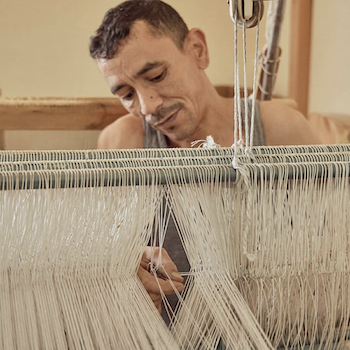
One of the most intimate things to do in Chefchaouen is to drop in on a local Berber weaver at his loom and watch while he produces a local style of red and white blankets.

Chefchaouen Wash Basin For Women, Reminiscent Japanese Rock Garden

Chefchaouen Wash Basin For Women, Reminiscent Japanese Rock Garden

If Moroccan travelers continue their exploration to the bottom of the hill in Chefchaouen, they will find women washing laundry in an area that resembles a Japanese garden filled with a variety of stones as well as miniature white open structures surrounded by a number of wide stairs that leads to a dam. 

For a panoramic view, you can hike to the top of Chefchaouen and, as you glide along the small streets, peer downward in search of the stone-carved Hand of Fatima that seems to reappear again and again throughout this blue city.

For more information about traveling to Chefchaouen

For more information about Travel and Tours to Morocco plus highlights on Moroccan culture visit Morocco’s Imperial CitiesSeaside Resorts,Sahara DesertBerber villagesA Taste of MoroccoMagical Kasbahs, Ruins & WaterfallsAbsolute Morocco, The Best of MarrakechFes, and Ouarzazate

Discover The Best of Morocco - Travel Exploration

Travel Exploration specializes in Morocco Travel. We provide Tours and travel opportunities to Morocco for the independent traveler and tailor-made tours for families and groups with a distinctly unique flavor. From Morocco’s Seven Imperial Cities, to the Magical Sahara Travel Exploration offers a captivating experience that will inspire you. At Travel Exploration we guarantee that you will discover the best of Morocco! Call Travel Exploration at 1 (800) 787-8806 or 1 (917)703-2078 and let’s book a tour to Morocco for you today.

Chefchaouen, Chefchaouen Tour, Chefchaouen Travel, Excursion to Chefchaouen, Fes to Chefcahoeun, Tangier to Chefcahoeun, Holidays in the Rif Mountains, Holidays in Chefchaouen, Riad Chefcahouen, Restaurant Chefchaouen, Kasbah Chefchaoeun, Rif Mountains, Fes, Tangier, Private Tours to Chefchaouen, 4×4 Tours to Chefchaouen, Trekking in the Rif Mountains, Trekking in Chefchaouen, Treks in Chefchaouen, Rif Mountain Treks, Rif Mountain Holidays, Rif Holiday Mountain Adventure, Rif Mountains Morocco, High Atlas Treks, High Atlas Toukbal, High Atlas Tichka,  Chefcahouen Crafts, Chefchaoeun Weavers, Mint Tea in Chefchaouen, Morocco private tours, Morocco Holidays, Morocco Travel, Travel Exploration, Travel to Morocco

Pasha Glaoui’s Legacy & Kasbahs in Morocco, Your Morocco Travel Guide

Friday, July 23rd, 2010
Pacha Glaoui

Pasha T’hami Glaoui was the most powerful man in Morocco between 1953 and 1956, in addition to being one of the richest men in the world at that time.  The title Pasha means Governor.  Glaoui was the Pasha of Marrakesh (since 1912), Ouarzazate, and most of the Moroccan south during the time Morocco was under French rule. The most important Kasbahs’ in Morocco that were occupied by the Pacha Glaoui during his reign and are frequented by Moroccan travelers today are Kasbah Taouirt, located in the center of Ouarzazate, Ait Benhaddou, located 15 kilometers outside Ouarzazate and Kasbah Telouet which sits in the village of Telouet nestled outside the Onilla Valley.

Glaoui Palace in Marrakesh during the days of Pacha Thami El Glaoui

As a result of the Pasha Glaoui siding with the French since the beginning of the 20th Century, Moroccans view Glaoui as a traitor.  However it was the Glaoui’s siding with the French which propelled him toward such enormous wealth and power.

Thami El Glaoui in center front row watching Paris dancers in Marrakech in 1952

So, how did Glaoui become so powerful?  Glaoui was born to Si Mohammed ben Hammou, who was a baron (also called a “caid” in Morocco) and his Ethiopian concubine Zora, in 1879.  Si Mohamed died in 1888.  T’hami became the teenage assistant of his eldest brother Si Madani, who took over after their father’s death.

Kasbah Taouirt Ouarzazate

In 1893, while Sultan Moulay Hassan was on a tax-gathering expedition, the two Glaoui brothers and their mother had the good fortune to save the sultan from a blizzard and starvation while he was on a tax-gathering expedition through the mountains.  To show his gratitude, the sultan gave the Glaouis a gift of the 77-mm Krupp cannon, which can now be viewed in the Kasbah de Taourirt in Ouarzazate.  At that time, this was the only such weapon outside of the imperial army.  The Glaouis used it to subdue rival warlords in the surrounding then-feudalistic society, which continued through the 1950′s.

77-mm Krupp Cannon given to the Glaouis

In 1907, Si Madani was appointed as the Grand Vizier to Sultan Moulay Hafid, and Thami was appointed as Pasha ofMarrakesh.

The Glaoui’s actual family name is El Mezouari, a name given to their ancestor in 1700 by Sultan Moulay Ismail.  El Glaoui refers to their belonging to the Glaoui tribe, which is mostly located around the 4 x 4 mountain pass of Telouet.  Many natives of Telouet now have the name Glaoui, but are not actually part of the El Mezouari family.

Glaoui Kasbah in Telouet

The Glaouis were already rich, and their early wealth was based on salt.   Their wealth continued to grow though what was brought by the camel caravans crossing the Sahara from as far away as Mauretania and Sudan.  Once Glaoui sided with the French, they gave him free reign in “pacifying” the South, as well as giving him both the olive and saffron trades, and Moroccan salt and mineral mines.  Glaoui also earned a substantial income from the red light district in Marrakesh known as the “Quartier Reservé.”

T’Hami El Glaoui (center) in LIFE Magazine

In 1953, Pasha Glaoui conspired with the French in the exile of Moroccan Sultan Mohamed V.  However, Mohamed V returned to Morocco in 1955 after the French decided Morocco was falling into chaos, and left, abandoning their support of Glaoui.  All of Glaoui’s property was siezed by the state, and his kasbahs fell into disrepair.  In 1956, Morocco gained independence, and Glaoui died.

Thami L’Glaoui

In recent years, much restoration has been done on the various Glaoui kasbahs, which are considered a very important part of Morocco’s heritage.

For more information about a Morocco Travel visit to the Pachi Glaoui’s Kasbahs in Morocco

For more information about Travel and Tours to Morocco plus highlights on Moroccan culture visit Morocco’s Imperial CitiesSeaside Resorts,Sahara DesertBerber villagesA Taste of MoroccoMagical Kasbahs, Ruins & WaterfallsAbsolute Morocco, The Best of MarrakechFes, and Ouarzazate

Discover The Best of Morocco - Travel Exploration

Travel Exploration specializes in Morocco Travel. We provide Tours and travel opportunities to Morocco for the independent traveler and tailor-made tours for families and groups with a distinctly unique flavor. From Morocco’s Seven Imperial Cities, to the Magical Sahara Travel Exploration offers a captivating experience that will inspire you. At Travel Exploration we guarantee that you will discover the best of Morocco! Call Travel Exploration at 1 (800) 787-8806 or 1 (917)703-2078 and let’s book a tour to Morocco for you today.

Pasha Glaoui, Pacha El Glaoui, Pacha Thami Glaoui, Pacha T’hami Glaoui, Glaoui Kasbah, Glaoui tribe, Glaoui wealth, Glaoui trade routes, Glaoui power, Reign of the Pacha Glaoui, Pasha Glaoui of Morocco, Moroccan history, Kasbah Taouirt, Ait Benhaddou Kasbah, Ait Benhaddou, Kasbah Telouet, Onilla Valley, History, Authentic Moroccan Tours, Americans Traveling to Morocco, Ancient Medinas in Morocco, Atlas Mountains Morocco, Berber Life,  Customized Morocco Tours, Discover Morocco, 4 x 4 Sahara Tours, 4 x 4 Tours Morocco, 4 x 4 Morocco, 4 x 4 Saraha Tours, 4 x 4 Tours from Agadir, 4 x 4 Tours from Marrakech,  4 x 4 Tours from Ouarzazate, 4 x 4 Toyota Land Cruiser, 4 x 4 Travel in Morocco, 4 x 4 Travel in Morocco’s Sahara,  4 x 4 Sahara Tours from Ouarzazate, 4 x 4 Sahara Tours from Marrakech,  Adventure Travel in Morocco, Camel Trek, Chegaga Sahara Desert Tour, Chegaga Tours 4 x 4, Desert Dream,  Five Tips for Morocco 4 x 4 Tour, Ouarzazate, Kasbah de Taourirt Ouarzazate, Casablanca, Rabat, Fez, Fes, Tangier, Marrakesh, Marrakech, Morocco private tours, Morocco Holidays, Morocco Travel, Travel Exploration, Travel to Morocco

How to Prepare Moroccan Terjla, Your Morocco Travel Guide

Wednesday, July 21st, 2010

Moroccan Terjla Prepared for the Table, as a Side Dish

Moroccan terjla (the Moroccan Arabic name) is frequently prepared as a side dish, and can be served either hot or cold.  Terjla, a succulent plant, known as purslane in English and verdolaga in Spanish, is not only one of the most delicious Moroccan plants, but it is simple to prepare.  Being a dark green plant, it is loaded with iron, vitamins, and minerals.  It also has a mild lemony flavor. When traveling to Morocco make sure to ask your Moroccan Travel Agency to recommend restaurants or local places where you can taste Moroccan terjla in a traditional restaurant.

Close-up View of the Moroccan Terjla Plant

Close-up View of the Moroccan Terjla Plant

Terjla is not often available in the major supermarkets because it is considered a traditional Moroccan dish, and the supermarkets often cater to products they feel will appeal to a broader audience of foreigners and less traditional Moroccans.  However, terjla can easily be found from late spring to late autumn in all the local vegetable markets.  The best place to find it in Marrakech is the small vegetable sellers just inside Bab Dukkala; however, it is found in many other places.  It’s a traditional staple in the cuisines of Fes, Casablanca, Tangier, Agadir, Ouarzazate, and Marrakech.

If you are traveling in Morocco, you are most likely to eat terjla in a private home.  If you are staying in a smaller hotel or riad and would like to try it, request it a day in advance, and they can look for it in the local market.  Most places would probably be delighted to prepare it for you.

How to Prepare Terjla

Traditional Moroccan Method:

Chopped terjla with whole garlic cloves

Discard any bruised leaves, and chop terjla (stems and leaves together) into 1/4″ (1/2 cm) pieces.  Put into a deep bowl.  Fill with water, and swish well; pour through a large strainer to drain out wash water.

Put terjla into water with some salt (it’s not a bitter plant, so take care not to oversalt it) and boil about 20 minutes until tender, but not limp). Drain water.

Season and toss gently with a clove or two (depending upon quantity) of freshly minced garlic, a little cumin, a little paprika, salt to taste (carefully) OR a very small piece of preserved lemon (but not if you added salt–use only one or the other), and a little olive oil.  Red olives can also be added.

Adapted Method which Yields Excellent Results:

Washed and trimmed terjla, ready to chop

Wash and trim the terjla of any bruised leaves (if it is just fresh from the market, it will only need to be washed).  I suggest swishing it two or three times in a deep mixing bowl of water.  Sometimes some very tiny black seeds will fall out if the terjla is in bloom.

Tiny terjla seed pods

But if there, these seeds are so tiny you don’t need to worry about them.  I trimmed off the tiny seed pods before chopping the terjla.

Chop terjla (stems and leaves together) into 1/4″ (1/2 cm) pieces.  Have ready one large unpeeled garlic clove for each cup of chopped terjla.

Two cups of chopped terjla placed in a steamer basket with two large garlic cloves

Choose one of the following cooking methods, both of which work:  boil chopped terjla with whole garlic cloves in plain water, or lightly salted water OR steam chopped terjla with whole garlic cloves in the basket for about 20 minutes.  (A Moroccan suggested the steam method to me, and I prefer it, since the vitamins don’t go down the drain with the boiling water.)

When the terjla is done, the garlic will be cooked inside.  Remove the garlic cloves, and carefully slice off the end.  The cooked garlic can be easily squeezed out into a small bowl from the opposite end.  Mash it into a paste with the back of a large spoon.  Add a small amount of black pepper and paprika to taste (1/8 tsp. of each for each cup of terjla).

slicing off the end of a cooked garlic clove squeezing a cooked garlic clove out of its skin garlic paste with black pepper and paprika in a bowl

Choose ONE of the following two : salt (lightly, to taste) OR a small piece of Moroccan preserved lemon (no more than 1/2 tsp. per cup of terjla, and take care not to use ANY salt).

Mix well, and add 1/2 Tbsp. of virgin olive oil for each  cup of cooked terjla (or more to taste).  Mix again well.  Add cooked terjla, and toss gently with a spoon until mixed well.  Optional, for olive lovers:  add two or three whole red olives for each cup of terjla.

Serve in side dishes at room temperature, warm on a cold day, or chilled on a hot day.  Terjla is delicious at any temperature.  Moroccans usually eat it with bread, as they do tagine; however, it may also be eaten with a spoon as a salad.

How to Find Terjla (Purslane) Outside of Morocco

Purslane grows in sunny areas from Canada to the Carribean, but is considered a weed in North America.  However, since it is a green vegetable used in Mexico and many Latin countries, you might be able to find it at Latin green grocers in North America.  (If collecting wild, take care that it is not in an area that has been deliberately poisoned as a weed.)

Wild summer purslane

According to experts, purslane contains more omega-3 fatty acids than any other green leafy vegetable plant.  It also contains vitamins A, C, and B, as well as iron, magnesium, calcium, and potassium.

Upright purslane species grown as a vegetable

Wild species often grow along the ground, while cultivated species often stand more upright.  It has been used both as a salad and medicinal plant with many uses for hundreds of years.  Purslane is commonly used in salads in France.  The plant is believed to be native to the area of India and Iran.

For more information about a Moroccan Terjla or a Taste of Morocco Private Tour

For more information about Travel and Tours to Morocco plus highlights on Moroccan culture visit Morocco’s Imperial CitiesSeaside Resorts,Sahara DesertBerber villagesA Taste of MoroccoMagical Kasbahs, Ruins & WaterfallsAbsolute Morocco, The Best of MarrakechFes, and Ouarzazate

Discover The Best of Morocco - Travel Exploration

Travel Exploration specializes in Morocco Travel. We provide Tours and travel opportunities to Morocco for the independent traveler and tailor-made tours for families and groups with a distinctly unique flavor. From Morocco’s Seven Imperial Cities, to the Magical Sahara Travel Exploration offers a captivating experience that will inspire you. At Travel Exploration we guarantee that you will discover the best of Morocco! Call Travel Exploration at 1 (800) 787-8806 or 1 (917)703-2078 and let’s book a tour to Morocco for you today.

Authentic Moroccan Tours,  Ancient Medinas in Morocco, Atlas Mountains Morocco, Berber Life, Customized Morocco Tours, Discover Morocco, Family Vacations in Morocco, Holiday Travel in Morocco, Imperial Cities Tour Morocco, Luxury Honeymoon Tour Morocco, Casablanca, Rabat, Fez, Fes, Tangier, Marrakesh, Marrakech, Agadir, Ouarzazate, Zagora, Moroccan Olive Oil, how to use Moroccan red olives, how to use Moroccan preserved lemons, Moroccan recipes with garlic, authentic Moroccan cuisine, Morocco private tours, Morocco Holidays, Morocco Travel, Travel Exploration, Travel to Morocco